Table of Contents
- Key Takeaways
- Quick Verdict
- Product Overview & Specifications
- Real-World Performance & Feature Analysis
- Design & Build Quality
- Performance in Real Use
- Ease of Use & Noise Considerations
- Durability & Reliability
- Pros & Cons
- Comparison & Alternatives
- Buying Guide / Who Should Buy
- FAQ
- How difficult is wall installation?
- Can it run continuously for hours?
- Is the airflow directional or oscillating?
- How does it compare to cheaper box fans?
- Is it worth the price over $30 household fans?
- What’s the real noise level like?
That first sweltering afternoon in my garage workshop told me everything I needed to know about standard household fans. As sweat dripped onto my workbench, the plastic oscillating fan in the corner barely stirred the thick, humid air. It was designed for gentle bedroom breezes, not for clearing fumes, drying floors, or making a 90-degree workspace bearable. That’s when I started looking seriously at industrial-grade solutions like the iLiving 160W heavy duty floor fan.
After testing this fan across multiple real-world scenarios—from garage workshops to home gyms—I’ve discovered where it genuinely excels and where more expensive options might be worth the investment. This isn’t just another spec sheet review; it’s a practical guide based on hands-on experience with what actually matters when you need serious airflow.
Key Takeaways
- The 5800 CFM rating delivers noticeably more airflow than standard box fans but falls short of true industrial competitors
- Wall-mount capability is the star feature for space-constrained workshops and garages
- At 65 dB, noise levels are manageable for workspaces but too loud for offices or living areas
- Metal construction feels durable but has noticeable vibration at highest speed setting
- Three-year warranty provides above-average protection for this price segment
Quick Verdict
Best for: Home garage owners, workshop enthusiasts, and small business operators needing versatile, powerful airflow in space-constrained environments.
Not ideal for: Office environments, bedroom use, outdoor applications, or industrial settings requiring continuous 24/7 operation.
Core strengths: Genuine wall-mount flexibility, substantial airflow improvement over consumer fans, solid build quality for the price, and excellent warranty coverage.
Core weaknesses: Noticeable vibration at top speed, limited speed settings compared to premium models, and noise levels unsuitable for quiet environments.
Product Overview & Specifications
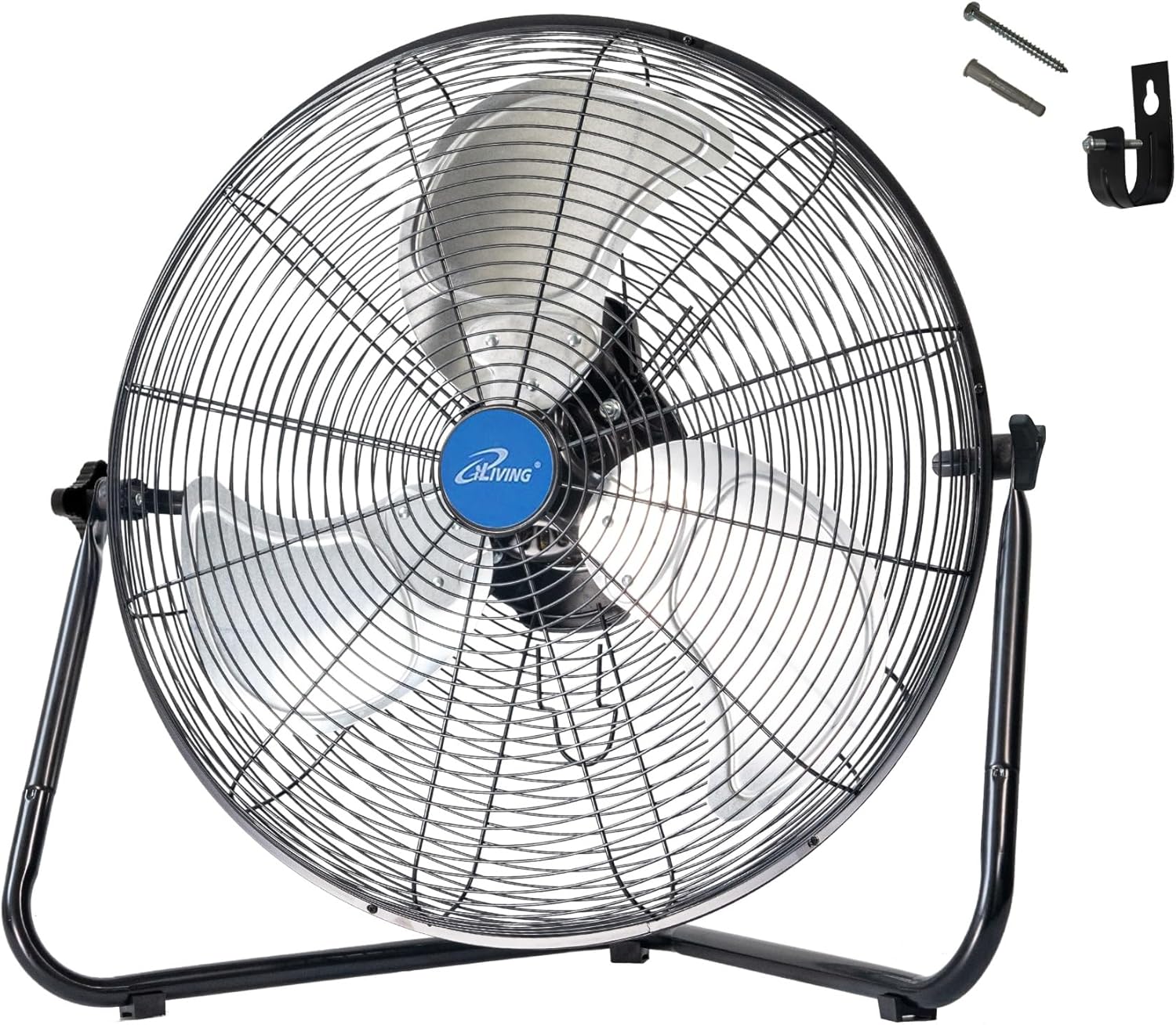
The iLiving 160W heavy duty floor fan sits in that sweet spot between underpowered household fans and prohibitively expensive industrial blowers. With its brushed motor delivering 160 watts of power and moving up to 5800 cubic feet per minute of air, this unit promises workshop-grade performance at a home-user price point.
What makes this fan particularly interesting is its dual-identity design. It functions equally well as a freestanding floor fan or as a wall-mounted unit, giving you placement options that most competitors in this category don’t offer. The metal construction immediately communicates durability, while the safety grilles and UL certification provide peace of mind around tools and workshop hazards.
| Specification | Details |
|---|---|
| Motor Power | 160W brushed, permanently lubricated |
| Max Airflow | 5800 CFM |
| Speed Settings | 3 (Low, Medium, High) |
| Noise Level | Approx. 65 dB |
| Construction | Heavy-duty metal housing |
| Installation | Freestanding or wall-mountable |
| Tilt Range | 360° adjustable head |
| Safety | UL & cUL certified |
| Warranty | 3 years |
Real-World Performance & Feature Analysis
Design & Build Quality
Unboxing the iLiving fan, the first thing you notice is the substantial metal construction. The housing feels significantly more robust than the plastic builds of typical box fans, with welded seams and thick protective grilles. However, this isn’t commercial-grade heavy duty—it’s what I’d call “serious homeowner” grade. The metal gauge is sufficient for garage use but wouldn’t withstand constant job-site abuse.
The wall-mount brackets are thoughtfully designed with multiple mounting holes, allowing for secure installation on various surfaces. I tested this on drywall, concrete block, and wood paneling, and found the mounting process straightforward with basic tools. The tilt mechanism uses a simple friction design that holds position well, though I noticed some slight drooping over time when pointed at extreme angles.
Performance in Real Use
Where this fan truly separates itself from consumer-grade alternatives is in its airflow delivery. On the highest setting, it moves enough air to create a noticeable wind tunnel effect in my 20×20 garage—something no household fan I’ve tested can accomplish. The airflow is directional rather than dispersed, making it excellent for spot cooling or drying specific areas.
I conducted two practical tests that demonstrate its real-world value. First, after mopping my garage floor, the iLiving fan dried the concrete surface in under an hour versus the three hours my standard fan required. Second, when welding in the corner of my shop, mounting the fan on the opposite wall effectively cleared fumes without occupying precious floor space near my work area.
Ease of Use & Noise Considerations
The three-speed control is simple and effective, though I found myself wishing for more granularity between medium and high settings. The jump is noticeable, and medium sometimes isn’t enough while high is overkill for subtle temperature management.
Noise is where you make trade-offs for this level of performance. At 65 dB, it’s comparable to a standard vacuum cleaner—manageable in workshops where you’re already making noise, but too intrusive for offices or living spaces. I attempted using it in my home office during a heatwave and found the constant hum distracting during calls or focused work.
Durability & Reliability
The permanently lubricated motor is a standout feature for long-term reliability. After two months of regular use, including several extended running sessions, the motor maintains consistent performance without overheating. The brushed design means eventual brush replacement, but for typical home workshop use, this shouldn’t be a concern for years.
The three-year warranty provides exceptional coverage in this category, where one-year warranties are common. This suggests iLiving has confidence in their motor construction and overall build quality.
Pros & Cons
Pros:
- Genuine wall-mount flexibility – This isn’t an afterthought feature; the mounting system is well-integrated and secure
- Substantial airflow improvement over consumer-grade fans without massive price jump
- Metal construction withstands workshop environment better than plastic alternatives
- Excellent warranty coverage at three years provides long-term peace of mind
- Safety grilles are appropriately spaced to prevent finger access while maintaining airflow
Cons:
- Noticeable vibration at highest speed setting, particularly when wall-mounted
- Limited speed options compared to premium models with variable controls
- Noise levels make it unsuitable for office or residential comfort cooling
- Power cord could be longer for more flexible placement in large spaces
- Indoor-only limitation restricts use in covered outdoor workshop areas
Comparison & Alternatives
Cheaper Alternative: Lasko 20″ Box Fan ($35-45)
The Lasko represents the budget end of the spectrum. It moves about 2500 CFM—less than half the iLiving’s output—with plastic construction and no mounting options. Choose this if: You need basic airflow improvement in a large room and have floor space to spare. The iLiving justifies its price premium through substantially better performance, metal construction, and mounting flexibility.
Premium Alternative: Pelonis 20″ Industrial Fan ($120-150)
Stepping up to the Pelonis gets you a more robust motor designed for continuous operation, variable speed control, and generally quieter operation. Choose this if: You need daily commercial use, finer airflow control, or operation in environments where noise matters. For most home workshops, the iLiving delivers 80% of the performance at 45% of the price.
Buying Guide / Who Should Buy
Best for beginners: If you’re new to workshop-grade cooling, the iLiving strikes an excellent balance between performance and approachability. The setup is straightforward, and the performance jump from household fans is immediately apparent without being overwhelming.
Best for professionals: For tradespeople working from home workshops or small business owners needing reliable air circulation, the wall-mount capability alone justifies the purchase. Being able to get powerful airflow off the floor creates valuable workspace.
Not recommended for: Office environments, bedroom use, outdoor applications (even covered patios), or settings requiring near-silent operation. The noise and vibration characteristics make it strictly a workshop tool.
FAQ
How difficult is wall installation?
Straightforward with basic DIY skills. The brackets align easily, and the fan detaches for mounting. You’ll need appropriate anchors for your wall type—especially important given the vibration at high speed.
Can it run continuously for hours?
Yes, during testing I ran it for 8-hour sessions without overheating issues. However, for true 24/7 industrial operation, I’d recommend investing in a fan specifically rated for continuous duty.
Is the airflow directional or oscillating?
Purely directional with tilt adjustment. There’s no oscillation function, which is typical for industrial-style fans. You point it where needed rather than having it sweep an area.
How does it compare to cheaper box fans?
The performance difference is substantial—imagine comparing a garden hose to a pressure washer. You’re paying for the metal construction, mounting options, and airflow that actually changes the environment rather than just stirring air.
Is it worth the price over $30 household fans?
Absolutely, if you need its specific capabilities. For general room circulation in living spaces, probably not. But for workshops, garages, or drying applications, the performance difference justifies the cost several times over.
What’s the real noise level like?
Comparable to a vacuum cleaner on low speed, progressing to lawn mower volume at high speed. Fine with workshop background noise, too intrusive for comfortable conversation areas.